Cindy and I enjoy John Piper’s “Solid Joys”, and in a recent devotion he said that even Satan believes in the resurrection; he saw it happen. So, part of what it means for us to believe Romans 10:9, to confess with our mouths that God raised Jesus from the dead is much more than accepting a fact. Piper wrote, “It means being confident that God is for you, that he has closed ranks with you, that he is transforming your life, and that he will save you for eternal joy.” I love that phrase, “he has closed ranks with you.” It means that he is with us. God said in Leviticus 26, “I will make my dwelling place with you.” He will not leave us. Jesus repeated that promise to his followers: “I am with you always, even to the end of the age,” and we see the foreshadowing of that all through the Old Testament. God is with his people. The tabernacle was a physical reminder of that promise in the wilderness. So though you may read the seven chapters in Exodus that describe in detail how it was built and think, “this is tedious,” I encourage you to read it under the banner “God is with us.” And with this truth underscoring every word: “The tabernacle and everything in it points to and is fulfilled in Jesus.” The one who was called “Immanuel.” God with us.
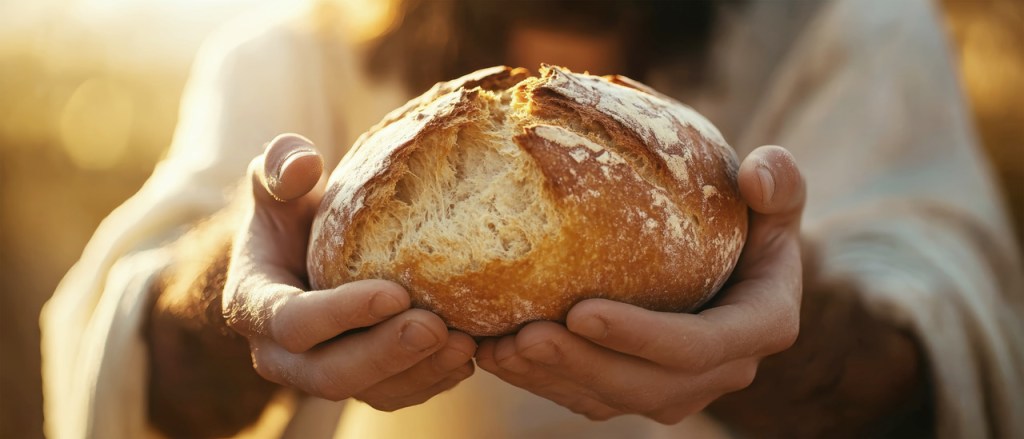
Why was the bread placed on the table of the Presence in the tabernacle every Sabbath? We are told it is a food offering to the Lord, but did God eat the bread? I mean, is God hungry? Does God need anything? No, God said, “If I were hungry I would not tell you, for the world and its fullness are mine.” Paul adds, “nor is he served by human hands, as though he needed anything, since he himself gives to all mankind life and breath and everything.” The bread on the table in the holy place where all the Jews could see it was a reminder that God is our provider. It was called the bread of the Presence because it was literally, “before God’s face.” And it was always there, just as God is always with us. Just as God always provides for us. How does this also point to Jesus? Bread was always on the table. Jesus said, “I am the bread of life,” and only Jesus who can satisfy our hunger. Wine was also on the table, and it was with bread and wine that Jesus illustrated the sacrifice he was about to make for his disciples and for us. He broke the bread and poured out the wine in the upper room. Then he did the same with his body and his blood on the cross. Broken and poured out by God who is for us.
We also see the provision of God on display in the lampstand. First, the lampstand brought light in a dark place, enabling the priests to do their work. The tabernacle had walls and a covering or roof that were several layers thick, made of linen and yarn and goatskins and rams’ skins. Second, the lampstand was shaped like a tree and though the Bible doesn’t fully explain its symbolism, some believe it was a look back to Eden and the tree of life. Our first parents lost that light as Adam and Eve sinned in the garden, but God had a plan for giving his people new light and life. The lampstand also looks back to creation and God’s first spoken words that started his eternal plan: “Let there be light.” Finally, the lampstand looks forward to the One who would say, “I am the light of the world. Whoever follows me will not walk in darkness but will have the light of life.”
God closes these instructions about the table and the lampstand with this: “And see that you make them after the pattern for them, which is being shown you on the mountain.” Why? Because the tabernacle and ark of the covenant and the table and the lampstand are, as Hebrews tells us, “a copy and shadow of heavenly things…Christ has obtained a ministry that is much more excellent than the old as the covenant he mediates is better, since it is enacted on better promises.”
Tim Keller was 22 years old when he heard Edmund Clowney, his professor at Gordon-Conwell, say that the Bible is either about what we’re supposed to do or it’s about what Jesus has done. More than 30 years later, Tim Keller taught the same truth as he gave his first public address for The Gospel Coalition to five hundred church leaders. He asked them, “Do you believe the Bible is basically about you or about him? Is David and Goliath about you and how you can be like David? Or is the story basically about Jesus, the one who really took on the only giants that can really kill us and whose victory is imputed to us? Who’s it really about? That’s the fundamental question. And when you answer that, then you start to read the Bible anew.”
The tabernacle points us to Jesus, who is the light and the life! Believe it. Live it. Tell it.
He is with us.

 J. Mark Fox
That’s deep the whole story really points back to Jesus. Even David beating Goliath wasn’t about David’s strength, it was about God’s power working through weakness — just like how Gideon’s army was reduced so that the victory would clearly belong to the Lord, not man.
LikeLike
Yes, in the midst of all of life’s problems, difficulties, and afflictions, it is good to know that “HE IS WITH US” sustaining us with his amazing grace. I trust that you are enjoying this nice weather. Blessings!Ted
LikeLike